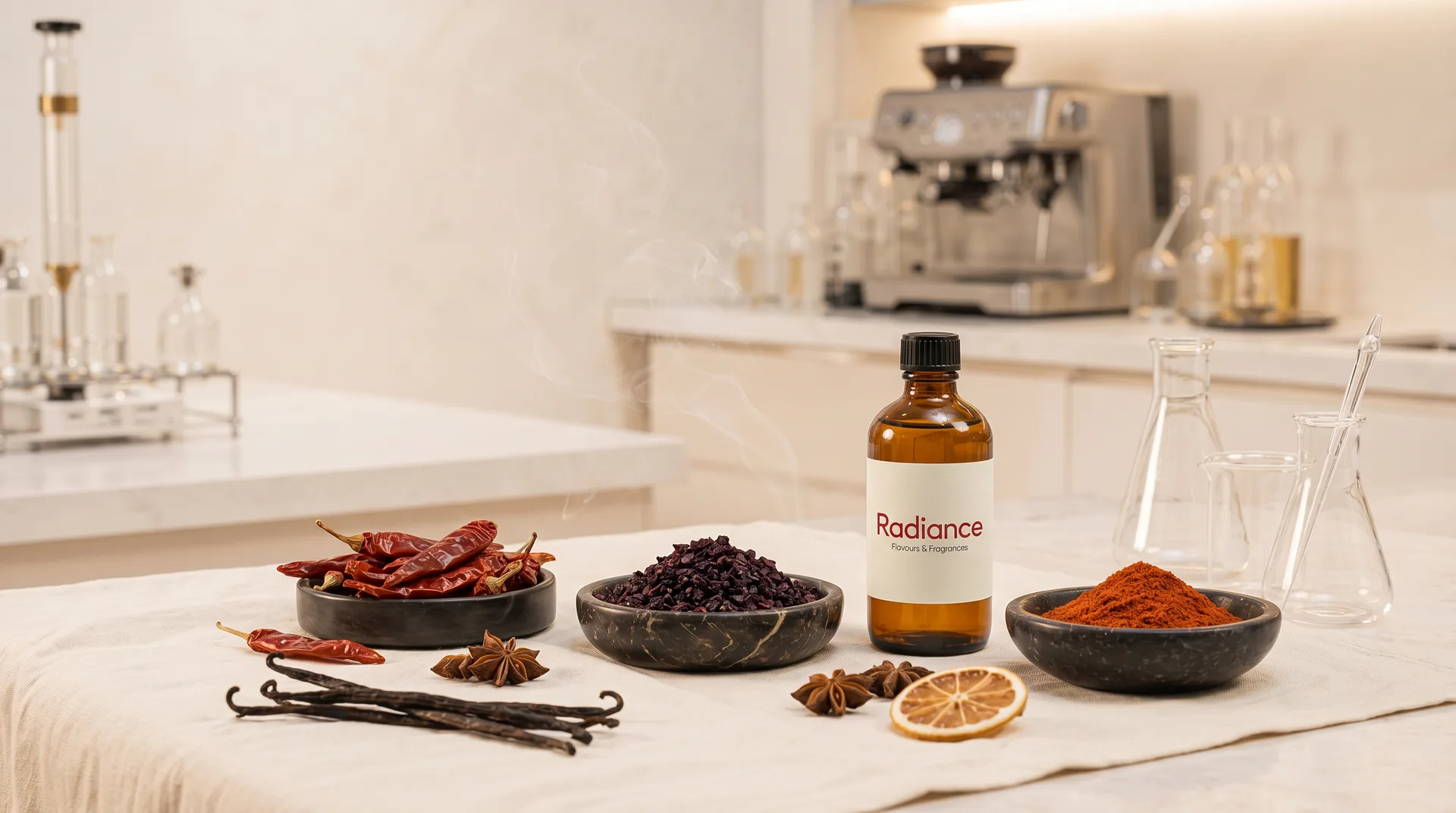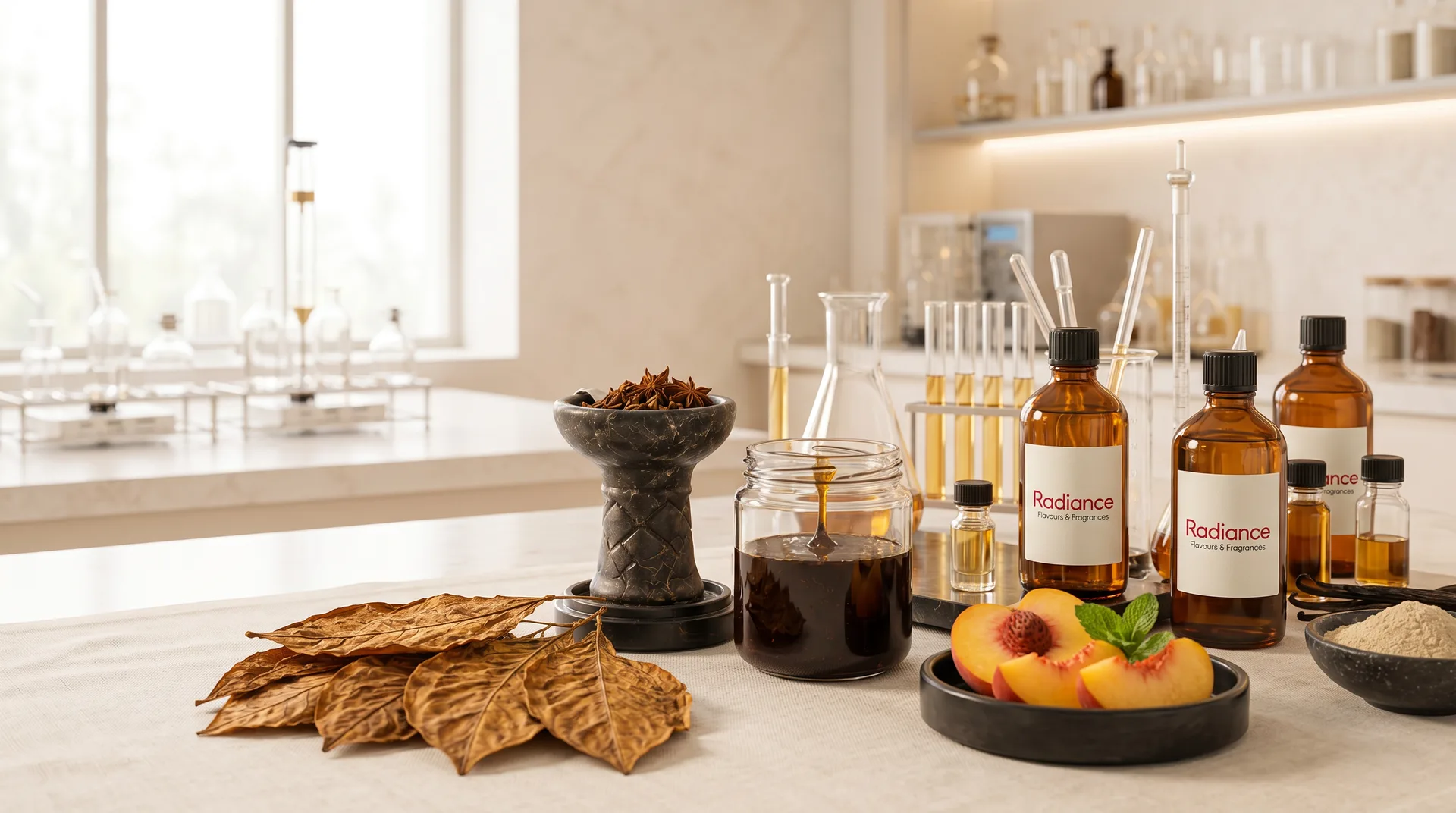
In shisha tobacco a flavour is tested not on the first draw but on the last. The category's shift towards layered composition may look like a shelf fashion, but behind it lies a rebuilding of formulation discipline.
Until a few years ago, things were relatively simple on the shisha tobacco shelf. Apple, mint, watermelon, grape. Single-note, recognisable, a promise written on the front of the pack. Today the same shelf carries recipes with three or four layers: "iced lemon-sage", "peach-black tea-bergamot", "melon-clotted cream-light spice". The consumer no longer expects a single taste but a construction that does not stand still across the session.
On the manufacturer's side, this means the brief has changed. Instead of "give us a strong strawberry", the sentence that arrives is "let it open fresh for the first ten minutes, let the body settle in the middle, let it leave a sweet trace at the end". The second is an engineering problem many times harder than the first.
The flavour lives inside a heating matrix
Evaluating a flavour on its own in shisha tobacco is misleading. The flavour dissolves inside a matrix formed by molasses, humectants such as glycerine and the leaf itself, and it emerges together with that matrix's behaviour under continuous heat. Glycerine both retains moisture and works as a vapour carrier; molasses brings both sugar and taste body; the leaf's own character rides on top. Teams that build the formula correctly on paper usually stumble in the field because they have not accounted for this matrix.
The critical variable is volatility. In a composition, the top notes (citrus terpenes, fresh green notes, volatile cooling agents) have low boiling points and evaporate rapidly the moment heat is applied. The middle and base notes (vanillin, lactones, heavy fruit esters, spice components) are released later and more slowly. If you do not construct that sequence deliberately, the top note is exhausted in the first three to five minutes and what remains is a bland, sugary body with no character. This lies behind almost every product a consumer describes as "great at the start, then the taste was gone".
A common trap here is automatically equating freshness with volatility. Menthol reads as fresh but it is a high-boiling, persistent component; it is still there at the end of the session. A note reading as "open and cool" in perception is not enough to file it under top notes; what decides is not perception but the physics of the component under heat.
A layered composition is a timeline
When you design a layered recipe you are designing not a single taste profile but a timeline. Splitting the session into three windows is a practical approach: opening, mid-session, close. You write down which note should dominate in each window, then choose the components capable of holding that note in that window. Passing on this timeline together with the target market in the sample request is the strongest input for steering development in the right direction from the very first round.
- Opening: highly volatile fresh and citrus notes; the aim here is the first impression and an easy draw.
- Mid-session: body and recognisability; fruit esters, tea and milk-type soft notes, the layer that carries the identity of the composition.
- Close: low-volatility base notes; vanilla, spice, sweet woody traces. But being non-volatile does not mean being heat-resistant; the degradation behaviour of this layer is tested separately.
Beneath these three windows there is a carrier note expected to stay constant across the session; usually the main fruit that gives the composition its name. It is what keeps recognisability standing while the windows change.
Once the timeline is set, the job becomes filling the volatility sequence with the right components. There is more than one component that delivers the same fruit character, and they differ greatly in their thermal behaviour. A peach note, for example, can be built with a light, volatile ester or with a heavy lactone. The two read similarly on a tasting spoon; in a shisha, one disappears at the eighth minute while the other is still there at the fortieth.
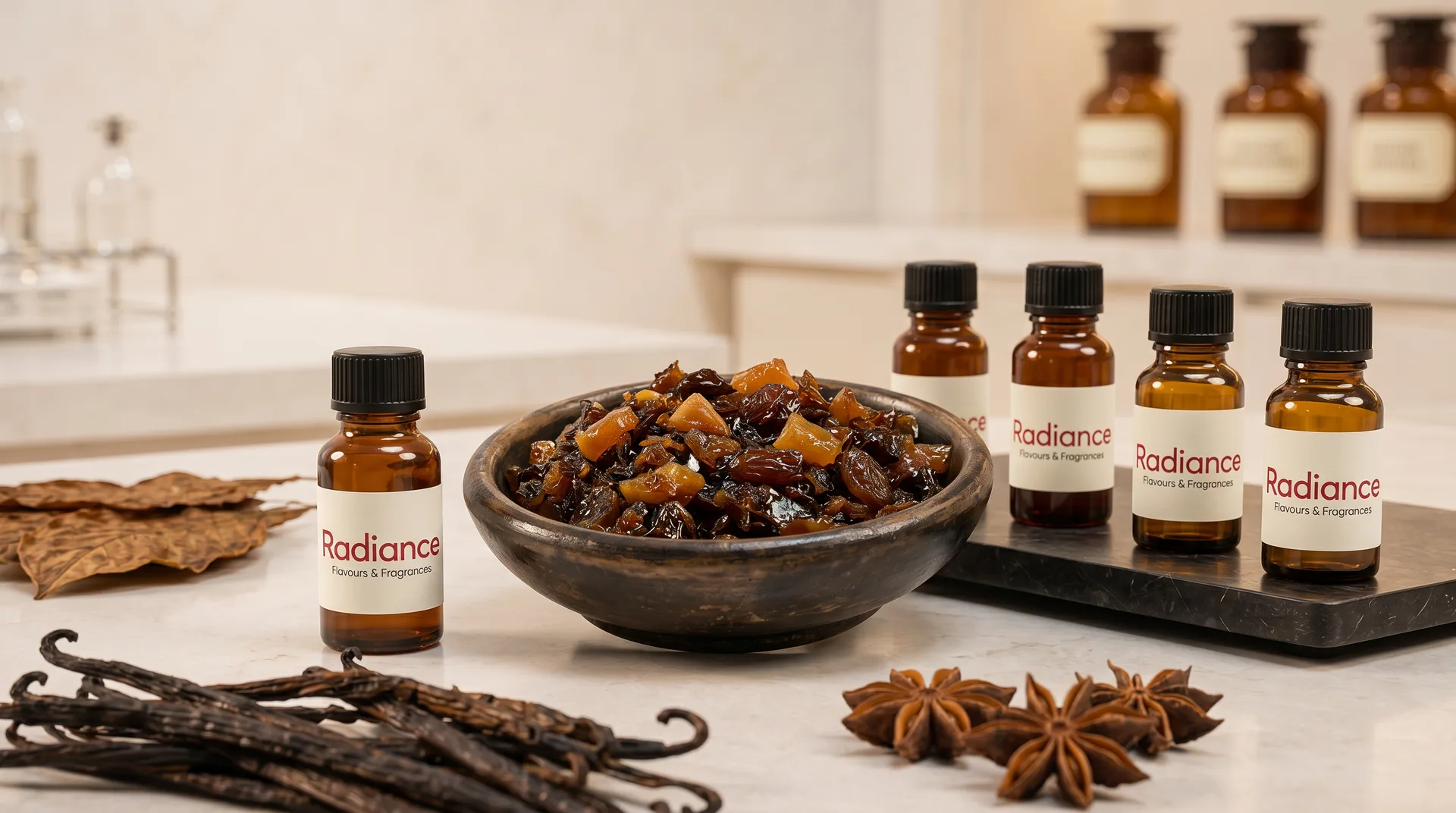
Casing and the flavour layer are designed together
A frequent mistake is treating casing as the "substructure" and the flavour as the "superstructure", and optimising the two separately. The sugar profile, acidity and moisture balance of the casing directly change how the flavour laid on top of it will be perceived. A high-sugar casing softens a sour citrus layer and makes it read sweeter than the consumer expects. A high-acidity casing sharpens the same citrus but delays the perception of the base notes.
That is why, in layered products, holding the casing constant and playing with the flavour dose rarely works. The right approach is to see the target timeline as the joint output of the casing and the flavour layer, and to re-tune the casing's sugar-acid balance according to the character of the composition. Most complaints of "the flavour does not hold" are in fact the casing overshadowing the flavour.
“In this category the fate of a composition is decided not by the first draw but by the draw at the fortieth minute.”
The decisive criterion: thermal stability
In food you test a flavour against process conditions, the shelf and the packaging. In shisha the test condition is harsher: the product is exposed to continuous, fluctuating heat throughout consumption. The position of the coal, the airflow, the user's draw frequency are all variables. Under those conditions a component either holds its stability or degrades and leaves behind a burnt, chemical or metallic off-note.
For that reason, in layered compositions the selection criterion is not only "is the taste right" but "how well does this component survive heat, and what does it leave behind when it degrades". The sensory panel must be designed accordingly: blind evaluation at not one point but at least three different moments in the session.
Thermal stability is also the key to repeatability. Behind the same formulation reading differently from batch to batch there is usually no dosage issue; there is a failure of the flavour to distribute homogeneously in the matrix, or the loss of delicate notes too early at the drying-maturation step.
A ready palette sets the pace of a new construction
The most exhausting part of building a layered composition from scratch is finding, for each layer, the component with the right volatility and durability profile. That work accelerates in direct proportion to the breadth of the palette you have. Radiance's portfolio of more than 750 shisha tobacco varieties serves exactly this function. If variants of the same fruit character with different volatility and durability profiles are within reach, the development process turns from a problem of "synthesis from zero" into one of "choosing the right layer".
The category will not go back to single fruit; the consumer expects a session to progress within itself. The first step towards building that is simple: take your existing product, taste it separately at the fifth, twentieth and fortieth minute of the session, and write down which note drops where. You cannot start designing a timeline without seeing the timeline of the product you already have.