Most sample processes are stretched not in the laboratory but at the brief stage. When the right information arrives on day one, it is possible to reach the target without ever getting to a second trial.
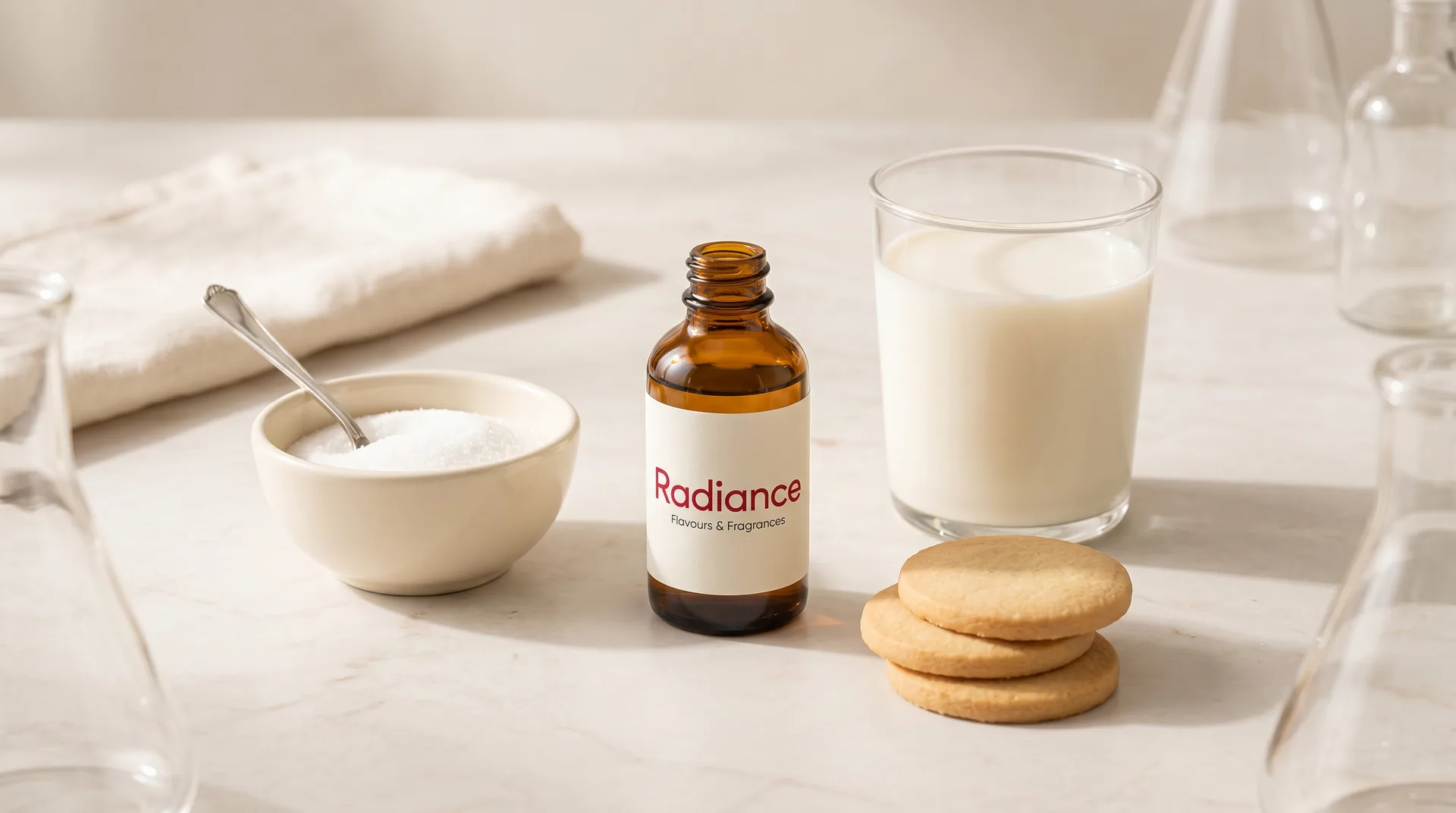
Every week we receive requests that begin "we want a vanilla flavour". That sentence is not a request; it is a starting point. Because the vanilla that has to survive 190 degrees in a biscuit dough and the vanilla that has to open up in a cold milk drink are two completely different products. Same name, same flavour family, an entirely different formulation.
Most second and third trials are the price of a question that was not asked in the first brief. Revision rounds are natural on a flavour's road from brief to series production; but some of those rounds can be prevented on day one. The headings below explain which information we ask for, why we ask for it, and what happens when it does not arrive.
The application matrix: where is the flavour going?
The first thing that determines a flavour's behaviour is the environment it will enter. In a fat-based matrix (chocolate, cream filling, fried snacks) fat-soluble components come to the fore and volatile top notes are suppressed. In a water-based matrix (beverage, jelly, sauce) the opposite happens: top notes burst out, but the body stays weak. In a powder product the carrier itself is part of the taste — a powder flavour on a maltodextrin carrier will not deliver the same intensity at the same dosage as one on a starch carrier.
What happens if this information does not arrive? The laboratory assumes the most common scenario and builds the sample accordingly. The sample reaches you, you try it in your own product, and the taste comes out "lacking". In fact the flavour is not lacking; it has been put into the wrong environment. You lose a round.
Process conditions: what is the flavour going to pass through?
Most flavour components are sensitive to heat and evaporation; encapsulated forms are additionally sensitive to mechanical stress, because there it is the capsule itself that breaks. Oven temperature and time, the pasteurisation or sterilisation regime, extrusion pressure, vacuum mixing — all of these file down volatile components at different rates. In extrusion, a significant part of the flavour escapes with the steam as the pressure drops; this is the condition most often forgotten in a brief. Freezing changes release and perception more than it causes loss: the flavour stays where it is, but it does not open up in the mouth the same way at low temperature.
The stage of the process at which you add the flavour matters at least as much as temperature. If it is added before heat treatment we build a different profile to compensate for the loss; if it is added afterwards — at the coating stage, for example — we can work with a much more delicate, more volatile formulation. The same target taste means two different formulations.
What happens if this information does not arrive? A profile that looks perfect on the laboratory bench may come out flattened once it leaves the oven. The flavour has not changed; what changed it was the process.
Dosage range and cost band
Technically, a flavour can be pushed to any intensity you want; the real question is whether that intensity fits the cost structure of your product. When you tell us "how much flavour do you plan to use per kilogram" and "what is the target share of this line item in the product cost", we build the formula inside that band from the start. A highly concentrated solution or a more economical but higher-dosage one — that is decided not by the taste but by the economics of the business, and the decision is yours.
What happens if this information does not arrive? The process resets the moment you see the price of the sample you liked. We will have hit the taste and missed the budget. This is the most expensive round to lose.
Target market, regulation and label constraints
Where the product will be sold determines what the formula is allowed to contain. Some components are unrestricted in one market and restricted in another; permitted maximum levels and labelling obligations vary from market to market. We build the formulation according to the current regulation of the target market — but first we need to know which market that is. If an export plan comes to the table later, the developed formula may have to be revisited.
Label constraints fall into the same category. Being free of allergens, halal or vegan compatibility, a "natural flavour" claim, avoiding certain additives — each of these narrows the pool of usable raw materials. They are things that need to be said at the beginning of the process, not at the end.
“Most of the time lost in a sample process is spent not in the laboratory but in the questions that were never asked.”
A short checklist
Before you send your request, make sure you have the answers to the following.
- Product and matrix: which product it will go into, fat-based or water-based, powder or liquid.
- Process: temperature and time, whether there is pasteurisation/extrusion/freezing, at which step of the process the flavour is added.
- Dosage and cost: the target usage rate and the target band for the flavour within the product cost.
- Flavour form: liquid or powder, any carrier preference or constraint.
- Target market: domestic or export, and which countries.
- Label constraints: allergen-free, halal, vegan, natural claim, components to be avoided.
- Shelf life expectation: how many months, in which packaging and under which storage conditions.
- Reference: a competitor product you like, an old sample, or the target profile you describe.
The power of a reference sample
Taste is the hardest thing to convey in words. Expressions such as "rounder", "too sharp", "not creamy enough" only go so far on a sensory panel. If you have a competitor product you like, a sample you import, or an old formulation you abandoned, send it to us. We analyse the profile and work by measuring the target rather than guessing at it.
By the same token, give your feedback in physical terms wherever you can: which note is too much, at which stage it disappears, whether it feels lacking in the mouth or in the nose, whether the problem is in the first bite or in the aftertaste. Feedback of that kind turns directly into an action in the laboratory.
A good brief, a short process
A request that arrives with the right information usually lands on target with the first or second sample; a request that arrives with information missing turns into a guessing game, and the price is paid in time.
Every sample we send you passes through the same controls, from raw material intake to batch analysis, that make up the laboratory's daily routine; the clearer the brief, the more accurately that effort is spent on the right target. Write down what you know, state plainly what you do not; we will fill the gaps together. What matters is that the process starts with a definition rather than a guess.